Ethiopia follows its own ancient Orthodox calendar, which means its major festivals (Timkat, Meskel, Genna, and Enkutatash) fall on different dates than their Western equivalents. Celebrated with processions, bonfires, and mass outdoor gatherings, these festivals are some of the most visually striking events in Africa.
Timket (Ethiopian Epiphany): January 19
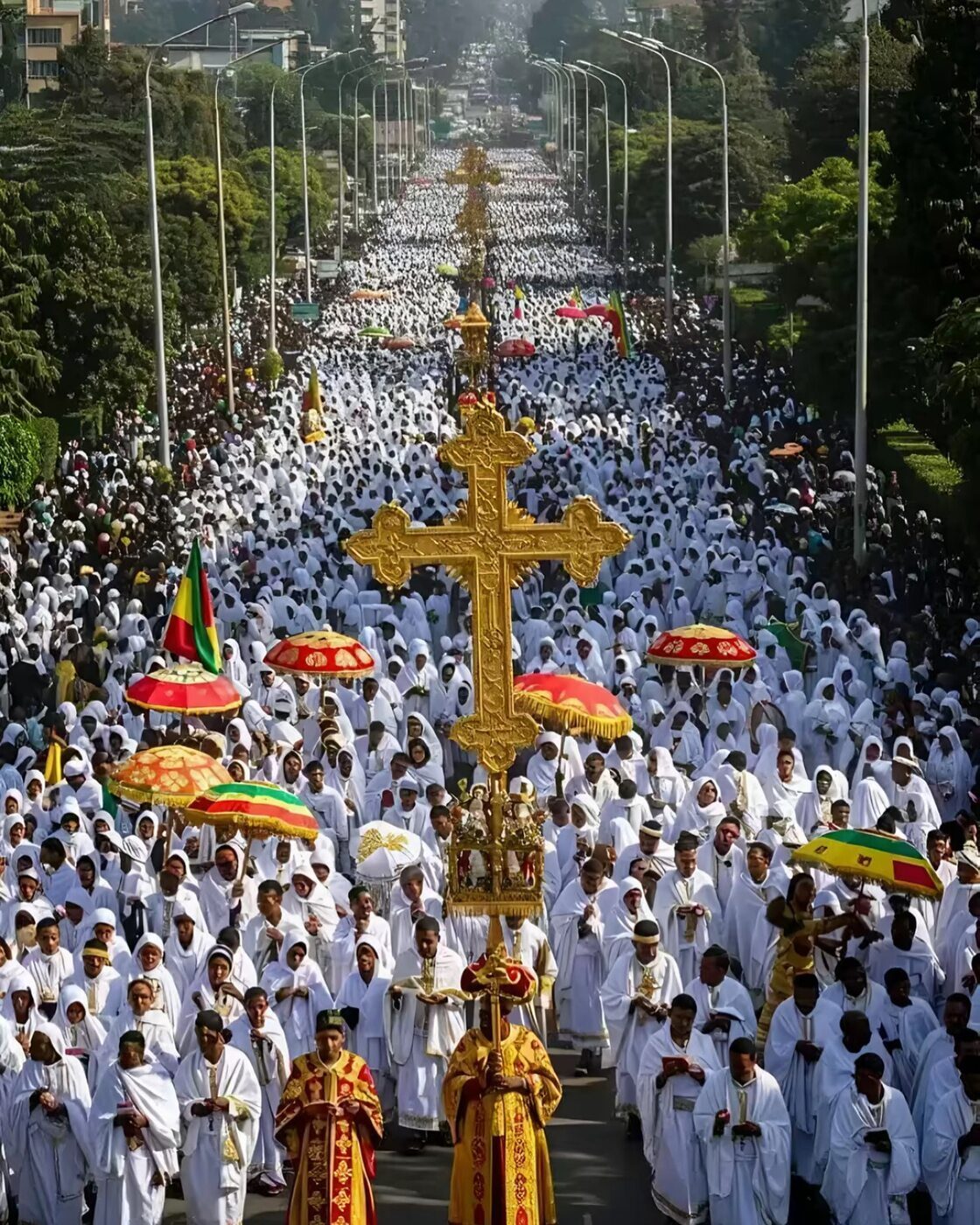
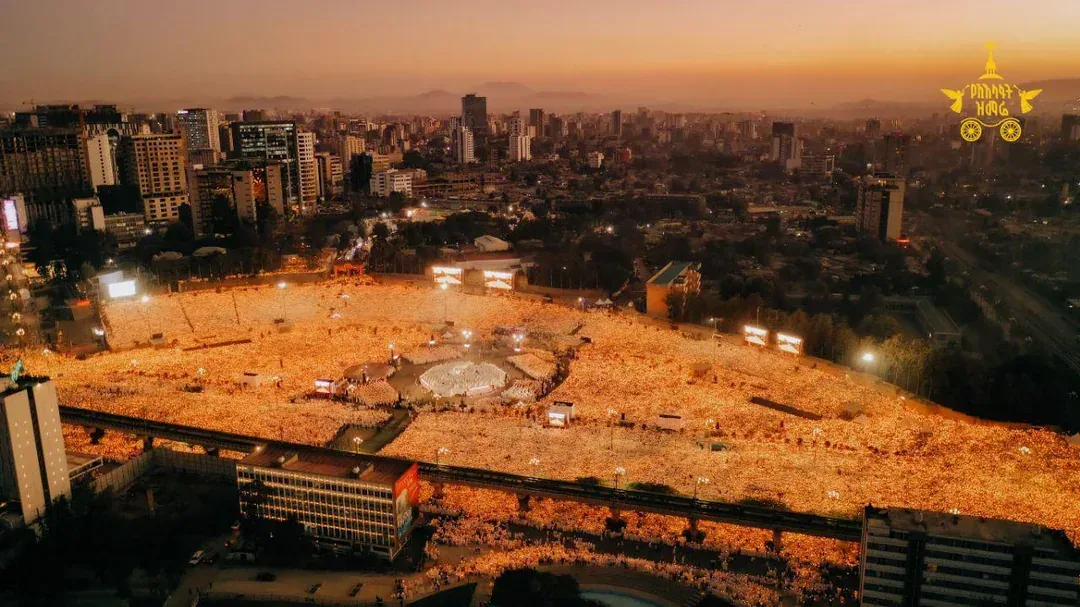
Timket is the single largest outdoor gathering in Ethiopia. More than 40 Tabots (sacred replicas of the Ark of the Covenant, one from each major church in Addis) converge on Jan Meda, a vast open field in the north of the city, on the afternoon of January 18. Priests carry them on their heads beneath embroidered ceremonial umbrellas, led by deacons in satin swinging censers of frankincense. The crowd, overwhelmingly dressed in white netelas, follows in waves: singing, clapping, ululating. By nightfall, the field holds hundreds of thousands of candles.
At dawn on the 19th, priests bless a pool of water to re-enact Christ's baptism in the Jordan. The most devout wade in. Golden light breaks over Jan Meda as the crowd sings. By mid-morning the mood has shifted completely: tej flows, vendors roast meat on open fires, and the reverence gives way to celebration.
Genna (Ethiopian Christmas): January 7
Twelve days before Timket, Genna arrives with a different, quieter energy. Church services begin at 6pm on Christmas Eve and run through the night, with priests circling the exterior of every church by candlelight, kebero drums booming in the dark. At Jan Meda around 2am, thousands gather for an open-air mass under the stars, many having brought picnic baskets and oil lamps for the long wait. It has an unusual quality: part solemn vigil, part family campout on a cold mountain night.
At dawn, a priest extinguishes a candle burning on a pole set in the Kebena River using a ceremonial cross. Horsemen join the processions home. Afterward, young men play the ancient stick-ball game Genna (the sport the holiday takes its name from) across open fields and streets around the city.
Adwa Victory Day: March 2
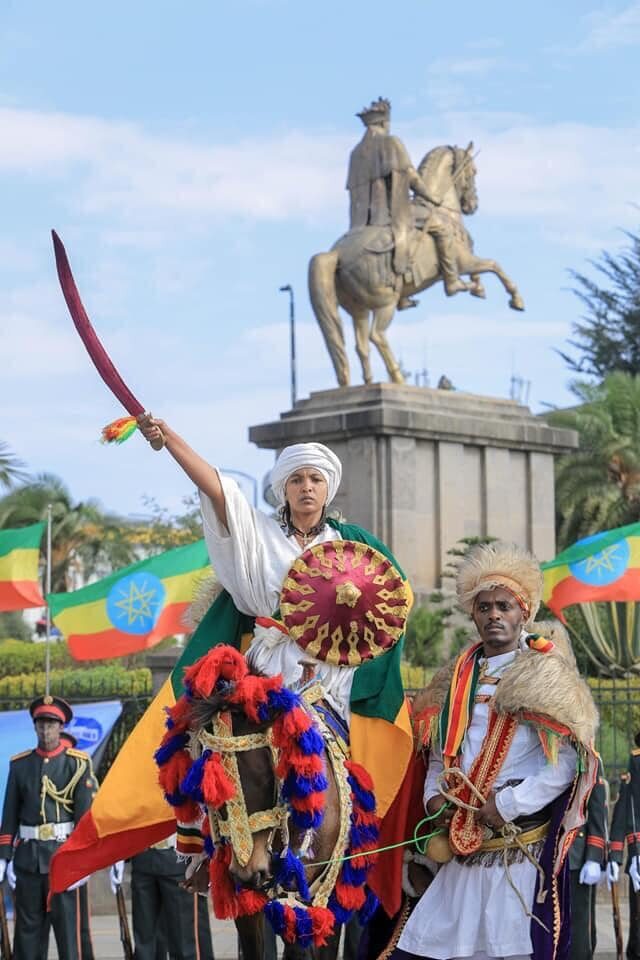
On March 1, 1896, Ethiopia defeated an Italian colonial army at the Battle of Adwa, the most decisive military defeat of a European colonial force by an African nation. Ethiopia was never colonized. Adwa Victory Day is the annual commemoration of that fact, and it carries real weight. The main ceremony unfolds at Menelik Square, in front of St. George Cathedral, where a wreath is laid at the statue of Emperor Menelik II. The Ethiopian Police Orchestra marches; senior officials and African Union diplomats attend.
The visual centrepiece is the participants' dress: men in jodhpurs and embroidered vests carrying traditional shields (gasha) and curved swords (shotel), women in habesha kemis or mourning black to honour those who fell. Performers deliver shilela (a warrior chant where lines of men advance, stamp, and shout in rhythmic unison) and fukera, a boastful verbal art somewhere between battle cry and poetry. Cultural performances and exhibitions continue through the afternoon at the Adwa Victory Memorial Museum.
Fasika (Ethiopian Easter): Date Varies
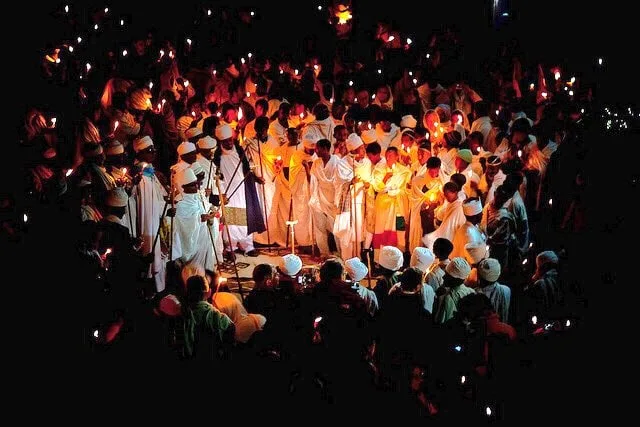
Fasika is the emotional peak of the Orthodox year, arriving after 55 days of strict fasting: no meat, eggs, or dairy for the devout. Every church in Addis holds the Paschal vigil. The most attended include Holy Trinity Cathedral (the burial site of Emperor Haile Selassie), St. Urael, and Medhane Alem in Bole. Services begin around 6pm on Holy Saturday and run past midnight: hours of liturgical chanting, kebero drums, incense, and candlelight in dim interiors.
At midnight, the announcement of the resurrection is made. Priests emerge from the inner sanctuary, church bells ring, and ululation erupts across the compound. The central flame is passed person to person until hundreds of individual candles illuminate the darkness. Then the fast breaks. Families return home between 1 and 3am to a table already prepared: doro wat, tej, injera. One of the most intimate and electric nights in Addis.
Enkutatash (Ethiopian New Year): September 11
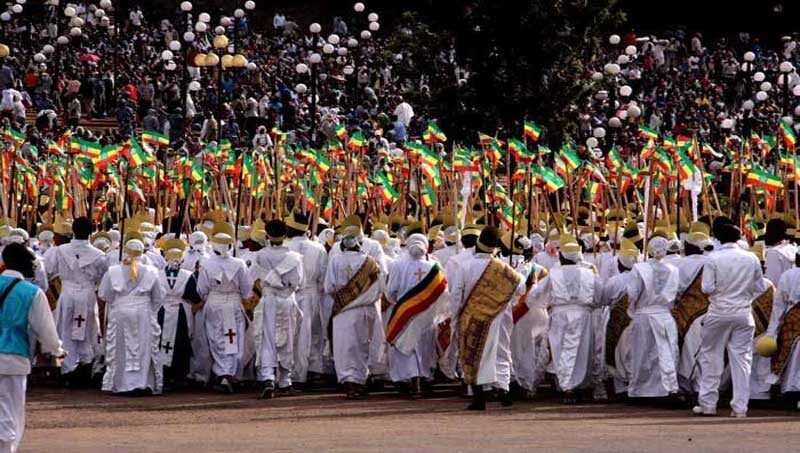
Enkutatash marks the end of the rainy season and the start of the Ethiopian New Year. Unlike Timket or Meskel, it radiates outward from homes and neighborhoods rather than a single square. On the eve of September 11, bonfires of eucalyptus branches and dried grass, called Chibo, appear in front of gates across every part of the city. From any high point, you can watch dozens of small orange fires bloom across the hillsides simultaneously.
At dawn, girls aged roughly 6 to 16 dress in hand-embroidered white habesha kemis and go door-to-door in groups, singing Abebayehosh ("the flowers have come") while carrying bouquets of the yellow adey abeba daisies that carpet the hills around Addis each September after the rains. By mid-morning the smell of fresh dabo bread is coming from every kitchen. Families wear new clothes, visit relatives, and eat doro wat together. The greeting is Melkam Addis Amet: Happy New Year.
Meskel (Finding of the True Cross): September 27
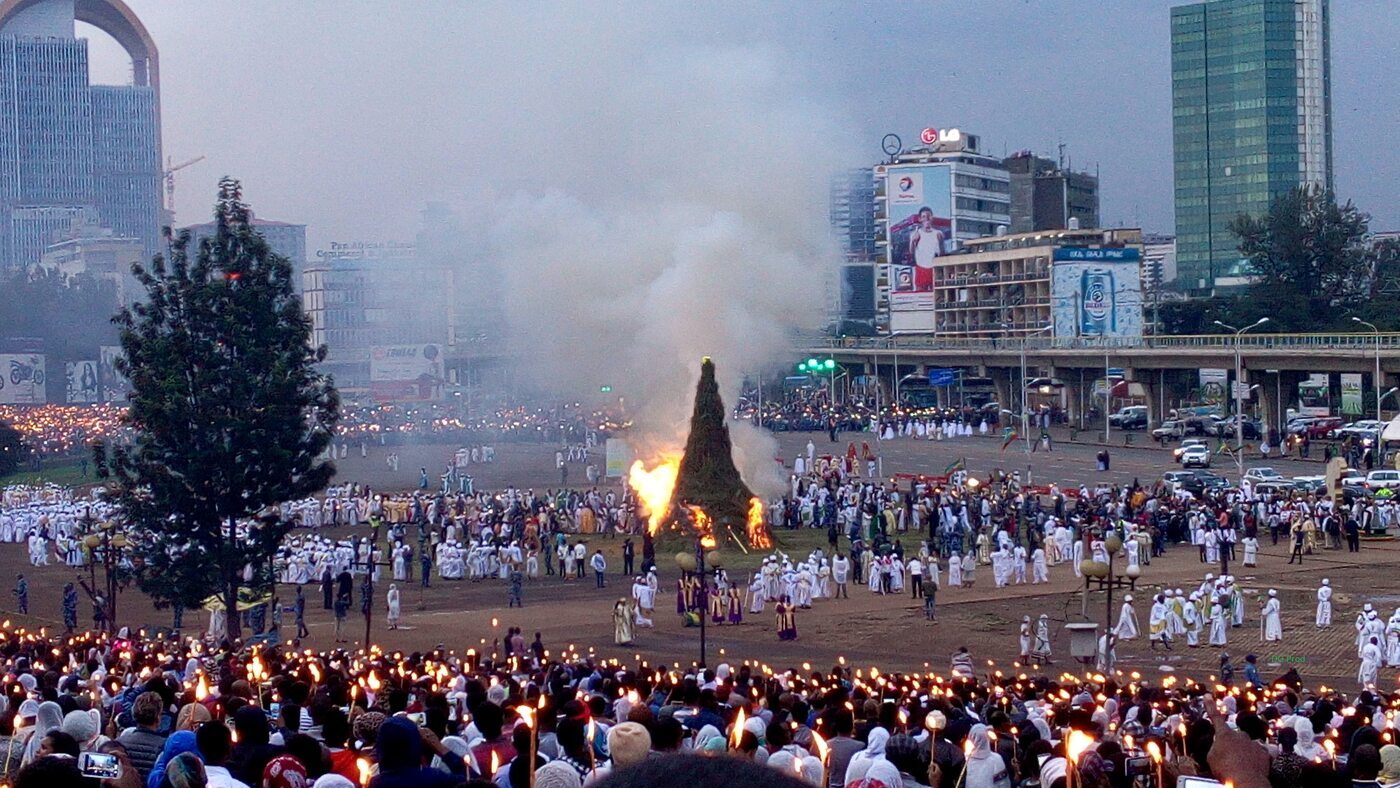
Two weeks after New Year, Addis Ababa's central square fills with one of the largest religious gatherings on the continent. Meskel commemorates Queen Helena's discovery of the True Cross in the 4th century and holds UNESCO intangible heritage status. The focal point is the Demera: a tall pyramid of bundled eucalyptus branches, topped with yellow Meskel daisies and crowned with a cross, erected at the centre of Meskel Square. It stands 10 to 15 metres high.
By mid-afternoon, hundreds of children from Sunday schools across the city arrive in white robes and coloured sashes, singing in call-and-response. Priests in embroidered velvet capes (deep reds, golds, greens) carry ornate processional crosses of gilded silver. As dusk falls, the Patriarch lights the Demera with a torch. The crowd watches which direction the smoke leans: tradition holds it points toward where the True Cross lies buried. When the flames catch the dry eucalyptus and the heat pushes back against the square, the chanting, incense, and smoke merge into something hard to describe and impossible to forget.
Id al-Fitr & Id al-Adha: Dates Vary
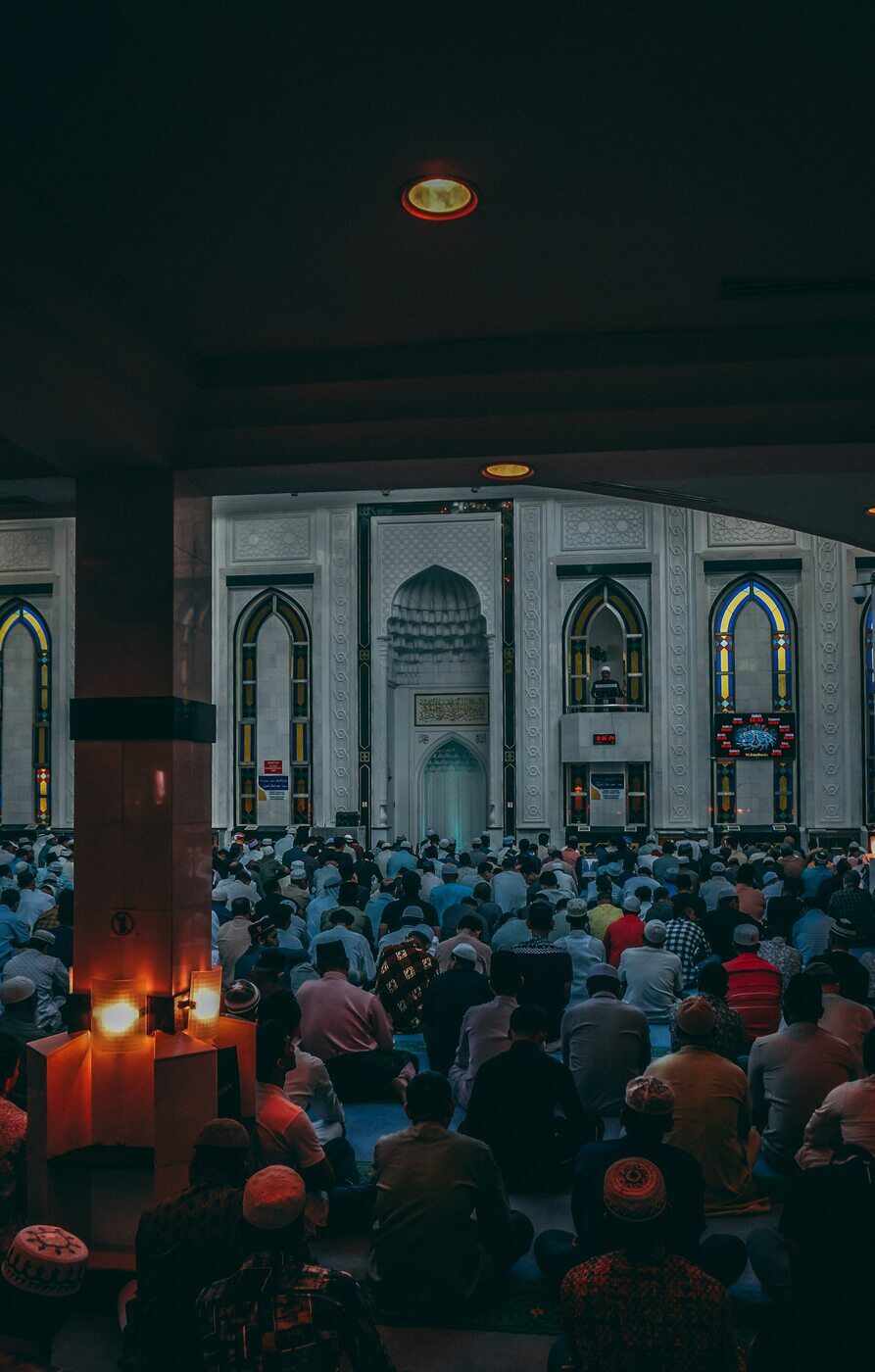
Ethiopia's Muslim community makes up roughly a third of the country's population, and both Eids are public holidays celebrated with real scale in Addis. The main morning prayer for Id al-Fitr takes place at Addis Ababa Stadium, where tens of thousands gather before dawn on prayer mats spread across the entire field. The Ministry of Defense fires nine cannon salutes at sunrise, audible across much of the city.
After prayers, the neighborhoods around Merkato and the Grand Anwar Mosque (the oldest and largest mosque in Addis, built around 1922) become street festivals. Families visit relatives, sweets and samosas are distributed to neighbors and passersby. For Id al-Adha, the ritual slaughter begins before 7am throughout Merkato; streets are impassable by mid-morning. A third of the sacrificed meat goes to family, a third to neighbors, a third to the poor; distributions to those in need are visible throughout the day.
Ethiopian Calendar
Ethiopia follows its own calendar: 13 months (twelve of 30 days and a 13th of 5 or 6 days), running roughly 7 to 8 years behind the Gregorian calendar. New Year falls in September, not January. Most religious festivals follow the Ethiopian Orthodox or Islamic lunar calendar, so dates shift year to year; always check before you travel.